




An e-bike suddenly caught fire while charging in a garage, with thick smoke engulfing the entire space in an instant—this was a typical scene among the over 200 e-bike fire incidents recorded by the U.S. Consumer Product Safety Commission last year. Today, solid-state battery technology is fundamentally changing this landscape.
01 Industry Inflection Point: Solid-State Batteries Break Through eBike Development Bottlenecks
2025 marks a turning point for the e-bike industry as solid-state battery technology finally moves from the laboratory to commercial application. The limitations of traditional lithium-ion batteries have long constrained industry development—liquid electrolytes are flammable and prone to leakage, energy density is approaching its theoretical limit, low-temperature performance is poor, and charging speeds are slow.
These technological bottlenecks have directly limited market acceptance and application scenarios for e-bikes.
According to data from the U.S. Federal Highway Administration, over 60% of daily commutes are within 20 miles, but the actual range of ordinary e-bikes under real road conditions often struggles to consistently meet this standard.
Solid-state batteries fundamentally address these pain points by replacing traditional liquid electrolytes with solid electrolytes. These solid electrolytes, typically made of ceramics, glass, or special polymers, not only eliminate flammability risks but also allow for the use of higher energy-density electrode materials.
A 2024 report from BloombergNEF indicates that the energy density of solid-state batteries is 40-50% higher than that of traditional lithium-ion batteries. This means a battery pack of the same size can provide a longer range, or for the same range, the battery volume and weight can be significantly reduced.
For the e-bike industry, this technological advancement is perfectly timed. Statistics from the U.S. Department of Energy show that U.S. e-bike sales exceeded 1 million units in 2023, but safety incident reports also increased by 35% year-over-year, with over two-thirds related to batteries.
02 Regulatory Adaptation: eBike Classifications Under U.S. Legal Framework and the Advantages of Solid-State Batteries
To understand the impact of solid-state batteries on the industry, one must first grasp the complex legal environment for e-bikes in the United States. U.S. federal law classifies e-bikes into three categories, upon which individual states have established their own regulations.
Class 1 e-bikes (pedal-assist, maximum speed 20 mph) are permitted on bike paths in all 50 states without requiring a driver's license or registration. Class 2 e-bikes (throttle-controlled, maximum speed 20 mph) enjoy the same road access as Class 1 in most states.
The regulations for Class 3 e-bikes (pedal-assist, maximum speed 28 mph) are more complex. For example, in California, Class 3 e-bikes are prohibited on certain bike paths, and riders must be at least 16 years old and wear a helmet.
The emergence of solid-state batteries may alter this regulatory landscape. Their enhanced safety could prompt regulators to reassess restrictions on high-power e-bikes.
The U.S. Consumer Product Safety Commission has begun focusing on solid-state battery technology, considering more flexible safety standards for e-bikes adopting this technology.
Data from the National Highway Traffic Safety Administration shows that in 2023, approximately 12% of traffic accidents involving e-bikes were related to sudden power loss caused by battery failure. The more stable discharge characteristics of solid-state batteries are expected to reduce this type of risk.
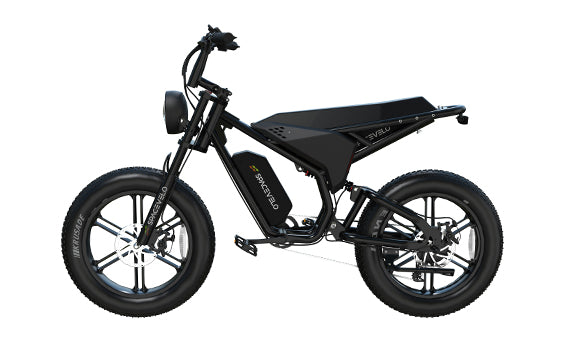
03 Innovation Case Study: How the SpaceVelo BLITZ S1 Defines a New Industry Standard
While many brands are still unveiling prototypes, SpaceVelo is bringing the future of solid-state batteries to reality with the BLITZ S1. This high-performance e-bike is designed from the ground up to fully harness the potential of solid-state battery technology, establishing itself as an industry benchmark for 2025.
At the heart of the BLITZ S1 is a dual solid-state battery system, a configuration previously impractical for traditional lithium-ion batteries due to weight and size constraints. Thanks to the higher energy density of solid-state cells, this setup provides double the available energy without increasing volume.
In real-world testing, the BLITZ S1 achieves an impressive 100+ miles of range on a single charge, effectively eliminating range anxiety for the vast majority of use cases. Furthermore, its AI-powered energy management system intelligently allocates power between the two batteries, optimizing discharge and charging cycles to maximize the battery's lifespan of 1500+ cycles.
The BLITZ S1's 750W high-performance motor works in perfect harmony with the solid-state battery, ensuring consistent peak power is available whether accelerating from a traffic light or climbing a steep incline. The battery not only lasts longer but also delivers power more robustly throughout the entire discharge cycle.
04 Safety Revolution: How Solid-State Batteries Redefine eBike Safety Standards
Safety is one of the most significant advantages of solid-state batteries. The liquid electrolyte in traditional lithium-ion batteries can trigger "thermal runaway"—a chain reaction leading to fire—under stressful conditions such as overcharging or physical damage.
The solid electrolyte in the BLITZ S1's batteries is non-flammable and physically stable, virtually eliminating this risk. This fundamental safety enhancement translates to a safer garage, a safer home, and a safer riding experience.
According to the National Fire Protection Association, the United States witnessed over 300 fires related to e-bike batteries in 2023, resulting in millions of dollars in property damage and dozens of injuries and fatalities. The widespread adoption of solid-state batteries is expected to significantly reduce such incidents.
Additionally, the solid electrolyte is less reactive with the electrodes, drastically reducing degradation over time. While a typical lithium-ion battery may experience significant capacity loss after 800-1000 cycles, the solid-state batteries in the BLITZ S1 are rated for 1500+ cycles.
This means years of reliable performance and greater overall value, making the BLITZ S1 an ideal choice not only for individual riders but also for commercial e-bike fleets that demand durability and low maintenance.
05 Regulatory Outlook: How Solid-State Batteries May Transform the U.S. eBike Legal Landscape
As solid-state battery technology matures, the U.S. e-bike regulatory environment may undergo significant adjustments. State legislatures are beginning to recognize that safer battery technology should correspond to more reasonable classification standards.
Currently, a primary concern restricting the use of Class 3 e-bikes is safety risk—the combination of higher speeds and potential battery issues could have serious consequences. By fundamentally addressing battery safety, solid-state batteries may prompt lawmakers to reconsider restrictions on this category of vehicles.
The National Association of City Transportation Officials has begun discussions on whether to create a new vehicle classification for e-bikes utilizing advanced safety technologies like solid-state batteries. This potential "Class 4" e-bike might retain the 28 mph maximum speed limit while gaining broader road access.
Such a classification change would significantly expand the practicality and appeal of e-bikes. Consumers would not have to compromise between safety and performance, and cities could promote sustainable transportation while ensuring public safety.
The Executive Director of the PeopleForBikes Coalition stated, "Solid-state batteries are a game-changer. We are working with state regulators to ensure that regulations keep pace with technological progress rather than hinder innovation."
06 Industry Impact: How Solid-State Batteries Reshape the eBike Ecosystem
The impact of solid-state batteries will extend far beyond individual product improvements; it will reshape the entire e-bike ecosystem. Charging infrastructure, insurance models, and shared mobility services will all evolve as a result.
Faster charging speeds mean reduced demand for high-power charging stations—solid-state batteries can be charged during a lunch break, unlike traditional lithium-ion batteries that require overnight charging.
The insurance industry has already taken note of this shift, with several major insurers considering lower premiums for e-bikes equipped with solid-state batteries, reflecting their reduced risk profile.
Shared e-bike service providers are particularly interested in the potential of solid-state batteries. Higher energy density means fleets can reduce the frequency of battery swaps, while longer cycle life lowers overall operating costs.
One of the largest shared e-bike companies in the U.S. has announced plans to convert at least 30% of its fleet to solid-state battery power by 2026.
Solid-state batteries are quietly transforming mobility on American streets. The significance of this technology goes far beyond a single product upgrade—it heralds a new era for personal transportation where safety, efficiency, and high performance coexist.